Core service
Epoxy vs Polyaspartic Garage Coatings in Florida Heat: Which Lasts Longer?

By Jimmie Wilson, owner of JW Painting & Pressure Washing & Epoxy Flooring
More than 30 years of hands-on painting and finishing experience
Published · Updated
- 5.0 on Google · 82 reviews
- Based in Jacksonville, FL 32254
- Where Precision Meets Perfection
Short answer
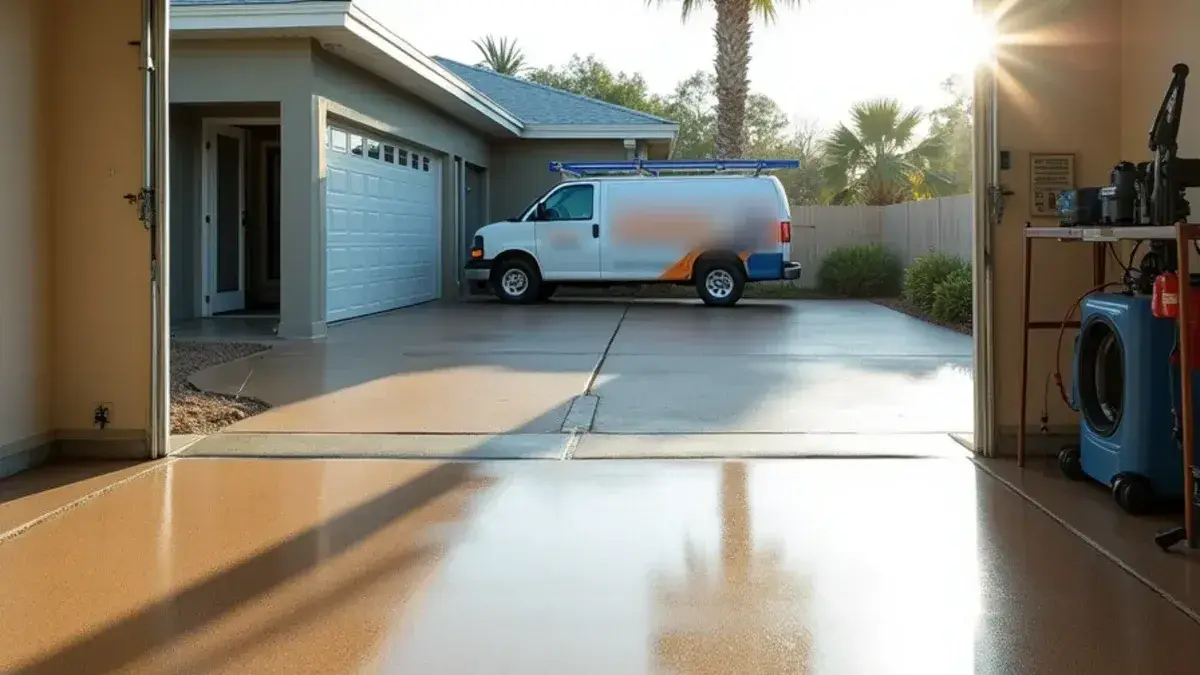
Neither chemistry wins on its own. Polyaspartic is UV stable and cures in about a day, so it holds color in a sunny Florida garage. Standard epoxy discolors in sunlight but builds thickness and bonds well. The floors that last longest usually pair a well-bonded base coat with a UV-stable topcoat over a properly ground slab.
Most homeowners comparing garage coatings hear two words: epoxy and polyaspartic. One salesperson says epoxy yellows. Another says polyaspartic is too brittle or too fast. In a Florida garage, the answer comes down to sun, heat, humidity and how the layers are combined. The products' own data sheets are the best place to start.
What is the difference between epoxy and polyaspartic?
Both are two-part coatings that cure by chemical reaction, not by drying. That is where the similarity ends.
Epoxy is the workhorse of floor coatings. Standard floor epoxies have long working times, build thickness well and bond strongly to properly ground concrete. Their weakness is light. Sika's data sheet for its Sikafloor-261 epoxy says plainly that it will discolor over time in sunlight and under some artificial lighting.
Polyaspartic is an aliphatic coating in the polyurea family. Aliphatic chemistry is what makes it UV stable. APF's data sheet for its Polyaspartic 7500 describes it as UV stable, with long-term gloss retention and resistance to yellowing. It also cures far faster, which is both its selling point and its challenge.
Here is how two real data sheets compare. These are single products, not every product of each type.
| Sikafloor-261 epoxy | APF Polyaspartic 7500 | |
|---|---|---|
| Working time | About 40 min at 68°F, 15 min at 86°F | About 20–30 min at 77°F |
| Foot traffic | About 1 day at 68°F | Light traffic about 4–6 hours |
| Vehicles or full cure | Full cure about 7 days at 68°F | Vehicles about 24 hours, full cure about 72 hours |
| Sunlight | Discolors over time under UV | UV stable, resists yellowing |
| Humidity during application | Up to 85% | Do not apply over 80% |
| Dew point margin | Slab at least 5°F above dew point | Air at least 5°F above dew point |
Which one handles Florida sun and heat better?
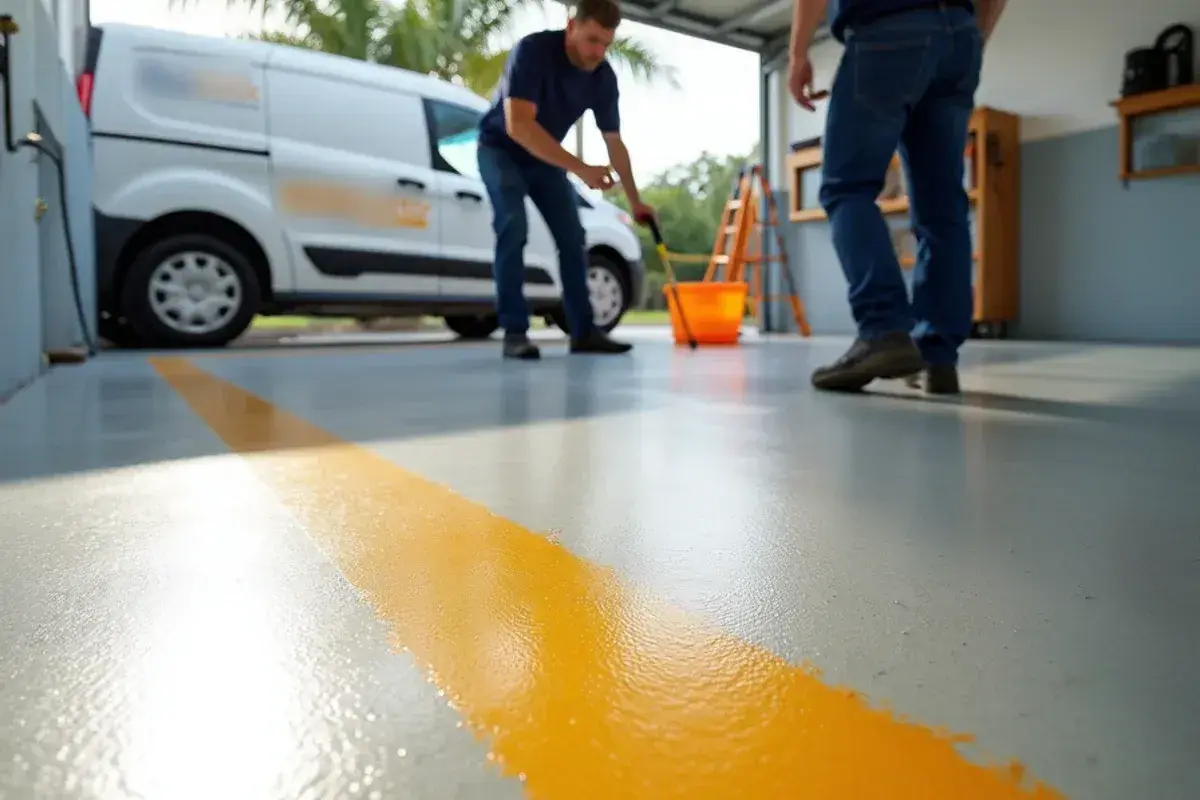
For sunlight, polyaspartic has the clear edge. Any garage that sits open in the afternoon lets UV reach the first few feet of floor. A standard epoxy there can turn amber while the back of the garage stays gray. A trade article from Westlake Epoxy, published in Paint & Coatings Industry, notes that the usual answer is a topcoat over the epoxy.
Heat is more complicated. APF's sheet says the polyaspartic's work life is considerably shortened above 90°F, and its application range tops out at 85°F. Jacksonville's July normal high is about 92°F. Epoxy's working time shrinks in heat too, but it starts from a longer window.
Humidity cuts the other way. Long-term climate tables put Jacksonville's average humidity near 89% at 7 a.m. and about 58% by late afternoon. Mornings are cooler but often too humid for the polyaspartic sheet's 80% limit. Afternoons are drier but hotter. On summer jobs, the right coating window can be just a few hours, and a crew has to measure rather than guess.
So which lasts longer?
Honestly, the label on the can matters less than three other things. There is no independent long-term study that settles "epoxy versus polyaspartic" for Florida garages, so be wary of anyone quoting a lifespan as fact.
- The bond. Coatings fail at the slab first. The concrete needs a real surface profile, graded on ICRI's CSP scale and produced by diamond grinding or shot blasting. Sika specifies CSP 3 to 4 for its Sikafloor-261.
- The film build. Thin films let hot tires win. Tires heated by driving soften thin or under-cured coatings and pull them up, while fully cured, higher-build systems resist that.
- The top layer. The surface takes the sun, the grit and the chemical spills. A UV-stable topcoat protects whatever is underneath.
Care plays a part too. Sand and grit carried in on tires act like fine sandpaper on any topcoat, so regular sweeping and a mat at the house door slow the wear. A floor that is rinsed of spilled fuel and oil promptly also keeps its finish longer than one that is left alone.
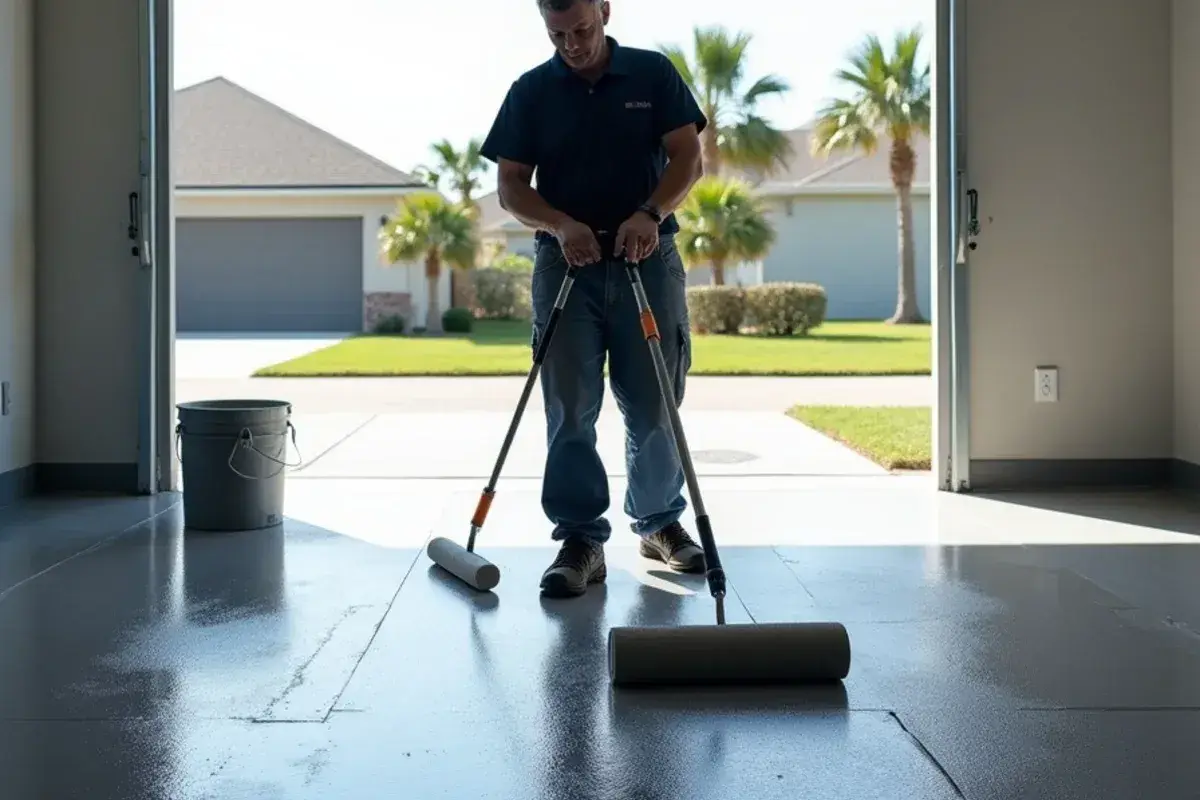
That is why many garage systems combine both. APF markets its polyaspartic as a finish coat for decorative flake and quartz floors. A typical build is a ground slab, a base coat, a full flake broadcast and a clear polyaspartic topcoat. Done well, that floor gets epoxy's build and bond with polyaspartic's color stability.
Trade-offs we weigh on the job
Every garage gets the same questions: how much sun does the floor see, what is the slab like, and how soon do you need to park? The answers shift the system.
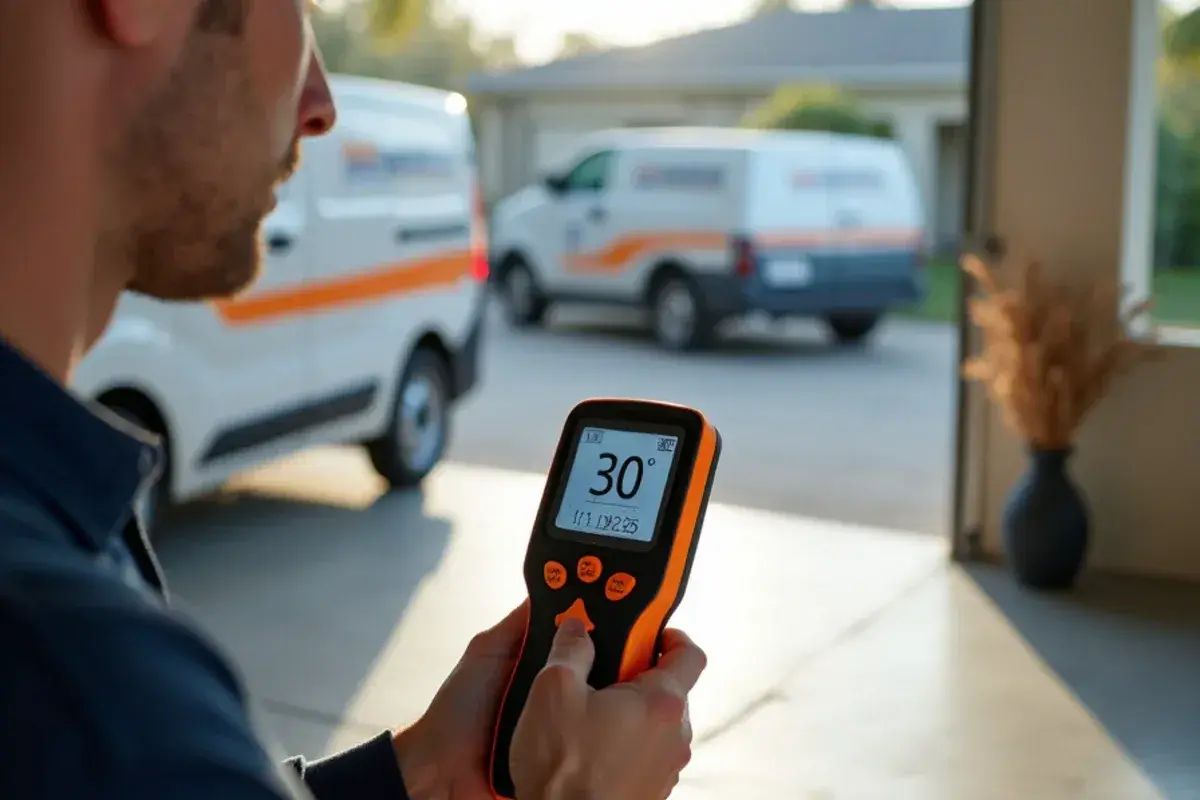
Near the ocean, salt air and slab moisture shape the plan. In Ponte Vedra Beach, many homes sit close to A1A and the beach, and every floor there starts with a moisture test. For a garage whose door faces the afternoon sun, a UV-stable topcoat also matters more than in one that stays shut. Up in Yulee, the questions are different. New slab homes around I-95 and SR-200, including Wildlight, often have young concrete still giving off moisture. Sika's epoxy sheet limits slabs to 85% on an ASTM F2170 test, so we test before choosing a primer.
Some other honest trade-offs:
- Speed versus forgiveness. Polyaspartic gets you parking in about a day. Its short working time means smaller batches and more hands on the floor.
- Recoat windows. APF's sheet says if its 24-hour recoat window passes, the surface needs preparation before the next coat. Fast systems leave less room for weather delays.
- Cost versus color. An all-epoxy floor in a garage that rarely sees sun can be a sensible choice. Paying for a UV-stable topcoat earns its keep where sun hits the floor.
Already have an epoxy floor that has yellowed or worn through? Our epoxy floor repair page explains how we choose between a topcoat and full removal. For a new floor, our garage floor epoxy page walks through each layer of a full system.
Checklist
- How much direct sun reaches the floor, and for how long each day?
- Which product goes on each layer: base, flake and topcoat?
- Will the slab be ground, and to what profile?
- Will the crew check slab temperature, humidity and dew point before mixing?
- How long until foot traffic, and how long until you can park?
- What happens if weather pushes a coat past its recoat window?
Frequently asked questions
Will an epoxy garage floor turn yellow?
Yes, it can, if sunlight reaches it. Sika's data sheet for its Sikafloor-261 epoxy says it will discolor over time under UV and some artificial lighting. A garage that sits open to afternoon sun gets the most exposure. A UV-stable aliphatic topcoat, such as a polyaspartic or aliphatic polyurethane, over the epoxy protects the color underneath.
Can polyaspartic go straight onto bare concrete?
Yes, some products are made for that, but check the data sheet. APF markets its Polyaspartic 7500 as a finish coat for flake and quartz systems. Its working time is only about 20 to 30 minutes at 77°F. Fast cure leaves little time to wet out a ground slab. Many installers use a slower base coat for the bond and polyaspartic on top.
How soon can I drive on each type of coating?
It depends on the product and the temperature. APF's polyaspartic data sheet lists vehicle traffic at about 24 hours at 77°F. Sika's Sikafloor-261 epoxy lists full cure at about seven days at 68°F and about five days at 86°F. Ask which product is going down and plan parking around its sheet, since a garage in July cures differently from one in January.
Can a yellowed epoxy floor be fixed without grinding it all off?
Yes, if the coating is still bonded well. Yellowing is a change inside the film, so cleaning will not remove it. A crew abrades the surface, cleans it and applies a UV-stable topcoat, which protects the color from then on. If the floor is also peeling or lifting at the tire paths, the failed areas have to be ground off first.
The bottom line
Polyaspartic wins on sun and speed. Epoxy wins on working time and build. In a Florida garage, the floor that lasts usually has both. That means a well-bonded base on a ground slab and a UV-stable topcoat, applied when heat and humidity allow.
If you want help choosing a system for your garage, call (904) 533-7260. We test the slab, look at how the sun hits it, and put the full system and timeline in writing.
Related
Services and areas from this article
Talk to a Jacksonville floor crew
Questions about your own floor after reading this? Call (904) 533-7260 and describe what you're seeing.
JW Painting & Pressure Washing & Epoxy Flooring · Jacksonville, FL 32254 · (904) 533-7260
Mon–Sat 7am–8pm · Sun closed